
“If I Know My Compulsions Don’t Make Sense, Why Can’t I Stop?” Understanding OCD and ERP

If you live with Obsessive-Compulsive Disorder (OCD), you’ve probably asked yourself this question more times than you can count:
“I know my compulsions don’t make sense—so why can’t I just stop?”
This question doesn’t mean you’re weak, unmotivated, or not trying hard enough. It means OCD is doing exactly what it does best: hijacking your brain’s fear system.
In this post, we’ll explain why compulsions feel impossible to resist and how Exposure and Response Prevention (ERP) helps retrain the brain—without forcing or overwhelming you.
🎥 Watch the short video explanation here:
Why You Can’t “Just Stop” Compulsions – YouTube Shorts
Compulsions Are Fear Responses, Not Bad Habits
Compulsions are often misunderstood as habits, quirks, or behaviours that someone could stop if they really wanted to.
In reality, compulsions are fear responses.
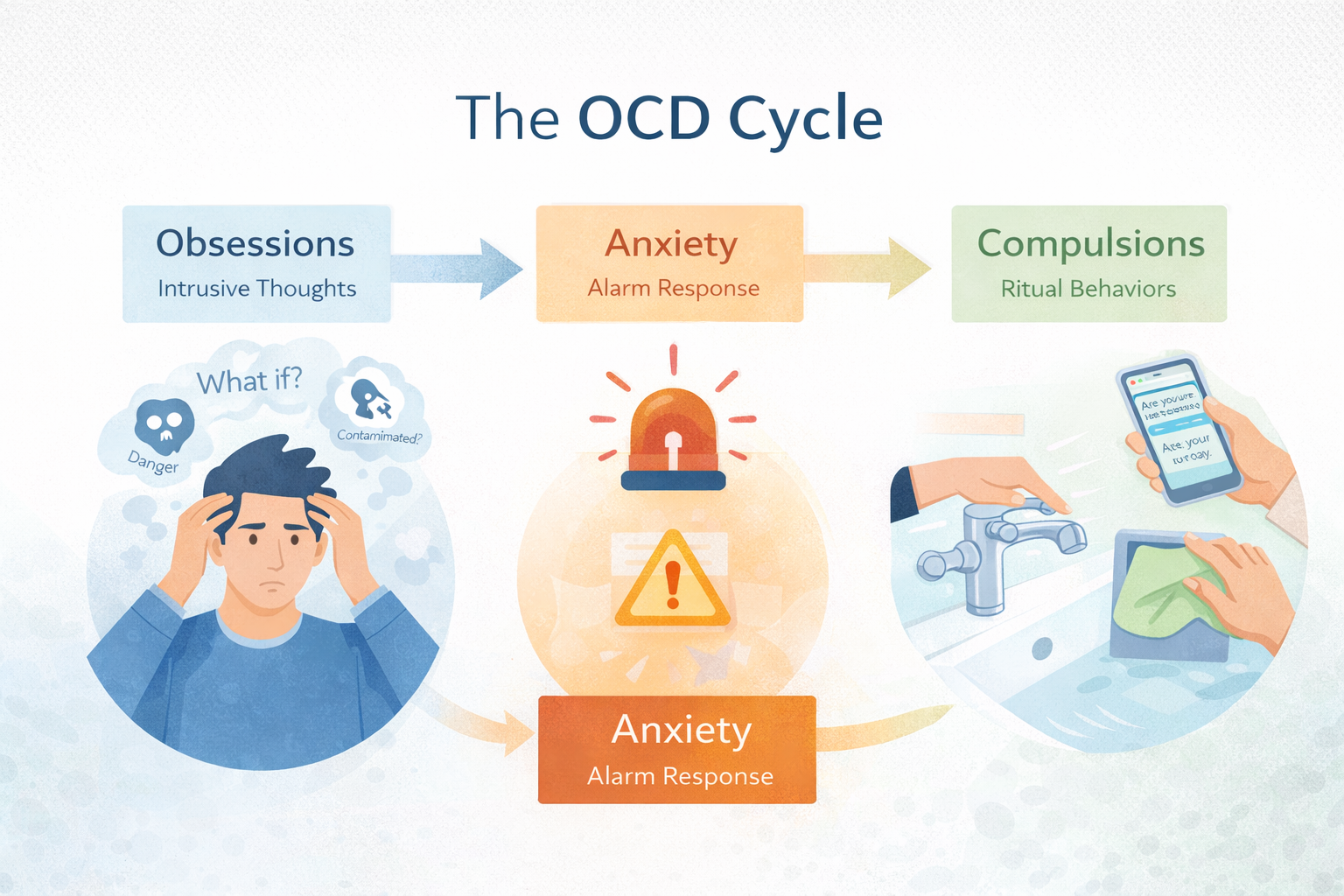
They are your brain’s best attempt to protect you from a perceived threat. When OCD is present, the brain misidentifies intrusive thoughts as danger—even when there is no real risk.
This activates your survival system:
- Fight
- Flight
- Freeze
OCD hijacks this system and convinces your brain that thoughts equal threats.
How OCD Traps the Brain
When an intrusive thought appears—
“What if I hit someone with my car?”—
your brain doesn’t treat it as a passing thought.
Instead, it sounds the alarm:
“Fix this. Make sure. Do something now.”
So you:
- Check your mirrors
- Drive back to the location
- Scan your memory for proof
Eventually, anxiety eases. And in that moment, your brain learns:
“That worked. This kept us safe.”
That relief is powerful—and reinforcing.
The next time anxiety hits, your brain demands the same ritual. Over time, compulsions become more urgent, automatic, and harder to resist—not because you’re choosing them, but because your brain has learned they are necessary for survival.
Why “Just Stopping” Compulsions Doesn’t Work
Many people understand that ERP involves exposure to triggers—but struggle to understand why they can’t simply stop their rituals.
The reason is important:
Your brain hasn’t learned yet that it’s safe without them.
Trying to force compulsions away without retraining the fear system often increases distress and backfires. ERP takes a different approach.
What ERP Actually Targets in OCD
Exposure and Response Prevention (ERP) is not just about facing triggers.
ERP is about facing the fear underneath the trigger.
Through ERP, individuals gradually:
- Experience intrusive thoughts or feared situations
- Resist or reduce compulsive responses
- Allow anxiety to rise and fall naturally
This process teaches the brain something new:
- Compulsions are not required for safety
- Anxiety can be tolerated
- Fear does not last forever
Importantly, ERP is not about forcing yourself to stop rituals. It’s about gradually reducing compulsions, building tolerance, and letting experience—not logic—do the teaching.
The Learning That Happens in ERP
Over time, ERP helps individuals gain powerful, corrective learning, such as:
- The feared outcome didn’t happen
- If something uncomfortable did happen, I could handle it
- The compulsion was not necessary
This learning is what weakens OCD at its core.
ERP at OCD Wellness
At OCD Wellness, we understand how frustrating it is to know compulsions don’t make sense—yet feel completely unable to stop them.
We specialize in evidence-based ERP therapy for children, teens, and adults, offering compassionate, individualized care that meets you where you are. ERP is done gradually, collaboratively, and with respect for your nervous system.
You are not failing OCD treatment—you are learning how your brain works. And with the right support, change is possible.