

What Makes OCD Wellness Different: Specialized, Empathetic, Evidence-Based Care

April Vass • January 21, 2026

By April Vass / CTSA-Certified ERP Clinician, MSW, RSW / OCD Wellness

OCD Wellness: Specialized, Compassionate Care for Obsessive-Compulsive Disorder


Living with Obsessive-Compulsive Disorder (OCD) can be isolating, exhausting, and often misunderstood. Many individuals and families find themselves navigating a confusing mental health system, receiving vague diagnoses and generalized treatments that fail to address the unique challenges of OCD. OCD Wellness was founded on the principle that those living with OCD deserve better—expert, compassionate care that is tailored, evidence-based, and deeply understanding of the disorder’s complexity.


A Personal and Professional Mission


OCD Wellness originated from a personal and professional realization: mental health support for individuals with OCD and related conditions is often limited and ineffective. While working in community mental health settings and hospitals, the founder observed that many individuals were not receiving accurate care for OCD symptoms. Struggles were frequently misclassified as generalized anxiety or depression. Standard therapies, such as talk therapy or conventional CBT, were often insufficient, leaving clients feeling misunderstood, hopeless and at times with worsening symptoms.

The challenge was not a lack of effort on the part of these individuals—it was that the system was not equipped to provide specialized support.


In Ontario, specialized care for OCD is scarce. While adult-focused resources such as Sunnybrook Hospital or Ontario Structured Psychotherapy exist, waitlists are long and services are often restricted. Pediatric options are even more limited. Families are frequently left to navigate a labyrinth of referrals, misinformation, and well-meaning but ineffective treatments.

OCD Wellness was established to fill this gap, offering accessible, specialized, and empathetic care for people with OCD and related disorders, including tics, Body-Focused Repetitive Behaviors (BFRBs), anxiety, and trauma.


A Clinic That Truly Understands OCD


The team at OCD Wellness is deeply trained, experienced, and focused exclusively on treating OCD and its related conditions. The clinic does not simply provide general mental health support—it specializes in understanding the complexities of OCD. The disorder is multi-layered, presenting in countless ways, from intrusive thoughts and compulsive behaviors to an overwhelming need for certainty, which can vary greatly among individuals.


There is no one-size-fits-all approach to treatment. Clinicians at OCD Wellness take the time to understand the core fears and functions behind each client’s symptoms, allowing them to deliver tailored, precise care that addresses the root of the problem rather than just the surface behaviors.


Evidence-Based, Compassionate Treatment


OCD Wellness provides gold-standard therapies supported by decades of research, including:


  • Exposure and Response Prevention (ERP): The frontline, evidence-based therapy for OCD, helping clients confront fears and resist compulsive behaviors in a structured, supportive way.
  • Inference-Based Cognitive Behavioral Therapy (I-CBT): Helps clients challenge faulty reasoning and beliefs that drive obsessions.
  • Comprehensive Behavioral Intervention for Tics (CBIT) is an evidence-based therapy that teaches awareness and competing responses to help reduce tic severity and improve daily functioning.
  • Habit Reversal Training: Helps clients recognize repetitive behaviors, such as tics or skin picking, and replace them with healthier alternatives.
  • Eye Movement Desensitization and Reprocessing (EMDR): A therapeutic tool for processing trauma, which can exacerbate or underlie OCD symptoms.
  • Prolonged Exposure For Trauma (PE): An evidence-based trauma treatment beneficial when OCD co-occurs with PTSD or severe anxiety.


Recognizing that OCD rarely exists in isolation, the clinic’s care model integrates treatment for co-occurring conditions such as trauma, anxiety, depression, and BFRBs, ensuring a comprehensive approach to mental health support.


A Warm, Individualized Approach


Unlike larger, impersonal clinics, OCD Wellness maintains a small-scale, client-focused environment. The clinic prioritizes creating a warm and welcoming atmosphere where clients feel seen, heard, and respected. Every individual is treated as a unique person, not merely a diagnosis.


Caseloads are intentionally kept manageable, ensuring that each client receives the attention and personalized care they need. Whether treating a child experiencing intense intrusive thoughts, a teen struggling with compulsions, or an adult who has faced years of untreated or undiagnosed OCD, the team at OCD Wellness walks alongside clients every step of the way.


Moving Forward, Together


Seeking help for OCD can feel daunting, particularly after previous treatment attempts that may not have worked. OCD Wellness emphasizes that no one is alone in this journey. Specialized, evidence-based, and compassionate care is available to help individuals and families regain control and live fully—without OCD dictating their lives.


OCD Wellness invites those seeking support to reach out and start a conversation – no diagnosis required. With individualized care and professional expertise, the clinic offers a pathway toward healing, growth, and renewed confidence.


A Takeaway Quote


“I must not fear, Fear is the mind-killer. Fear is the little-death that brings total obliteration. I will face my fear. I will permit it to pass over me and through me. And when it has gone past I will turn the inner eye to see its path. Where the fear has gone there will be nothing. Only I will remain.” - Frank Herbert, Dune

By April Vass February 24, 2026
At OCD Wellness , we hear the same painful story far too often. Years spent suffering in silence , weighed down by shame, fear, and confusion . Individuals and families who tried to get help—only to be misunderstood , misdiagnosed, or given treatment that unknowingly made things worse . The same cycle: feeling stuck, afraid to trust, and wondering if things will ever get better. We’re here to tell you: things can get better. You are not alone. And the first step can start today. Why So Many Wait—and Why You Don’t Have To One of the most heartbreaking truths about OCD is how long people wait before getting the right help. Many of our clients have spent years hiding their struggles , afraid of being judged, afraid of what their thoughts might mean, or afraid that no one will understand. Others have reached out for support only to be given general talk therapy or traditional CBT , which—while helpful for many mental health concerns— doesn’t work for OCD . In some cases, these well-meaning interventions can feed into the OCD cycle , increasing doubt, compulsions, and shame. The longer this cycle continues, the stronger OCD becomes. Here’s why: The more we complete compulsions , the more we teach our brains to distrust ourselves —our thoughts, our senses, our intentions. Every time a compulsion “works” to reduce anxiety, it sends the message that the fear was real, the threat was valid, and that only OCD can keep you safe. Over time, this builds more doubt , more fear , and more shame —creating a life dictated by OCD, not by your values. Early Intervention Strengthens YOU, Not OCD The sooner we begin evidence-based treatment , the sooner we stop strengthening OCD—and start strengthening you . At OCD Wellness, we specialize in Exposure and Response Prevention (ERP) and Inference-Based CBT (I-CBT) —the gold-standard treatments for OCD. These approaches help retrain your brain to face fear without compulsions, rebuild self-trust, and reduce the anxiety and shame that OCD thrives on. Every step you take toward treatment is a step toward freedom, peace, and confidence . Even something as small as booking a consultation call can be the beginning of change. We know it can be scary. But it’s also incredibly powerful . You don’t have to figure this out on your own. You don’t have to live in fear any longer. Flexible Support—You’re Not Alone At OCD Wellness, we offer hybrid care , meaning you can receive therapy virtually or in person , depending on what feels right for you. We believe in meeting you where you are —literally and emotionally. In addition to individual therapy, we offer: A clinician-led peer support group for individuals with OCD who are ready to connect with others who understand. A parent support group , designed to help caregivers support their loved ones with OCD while taking care of themselves. Coming soon: Online OCD & ERP modules that walk you through what to expect in treatment—perfect for anyone who wants to feel informed and ready to hit the ground running. If you’re interested in joining a group or being notified when the modules launch, we welcome you to reach out by email or phone . You Deserve a Life Beyond OCD Too many people have been told to “just stop worrying” or “try to relax.” Too many have received incorrect or incomplete treatment that left them feeling defeated or afraid to try again . Let us assure you (this one time): OCD is highly treatable —and the right support makes all the difference. With specialized care , you can live well with OCD —not ruled by it. Take the First Step Today There’s never a perfect time to begin—but starting now can change everything. The sooner we address OCD, the sooner you can stop reinforcing fear and start building strength . You deserve compassionate, effective support —and we’re here to provide it. Reach out to OCD Wellness today. Let’s take that first step—together. Interested in Our Upcoming Programs? OCD & ERP Modules Launching Soon – Learn the basics of OCD treatment and prepare for therapy with confidence. Clinician-Run Peer Support Group – Connect with others walking a similar path. Parent Support Group – Learn how to support your loved one while caring for yourself. Contact us to learn more or sign up: 📞 (705) 417-3250 📧 info@ocd-wellness.com 🌐 www.ocd-wellness.com
By April Vass February 24, 2026
Living with Obsessive-Compulsive Disorder (OCD) can feel like an unrelenting cycle of fear, doubt, and the desperate need to feel “just right” or certain. Many people suffering from OCD describe feeling stuck, misunderstood, or hopeless—especially if they've tried treatments in the past that didn’t help. At OCD Wellness , we want you to know: healing is possible . With the right treatment, support, and guidance, people with OCD can regain their lives, reconnect with their values, and find peace—even in the presence of uncertainty. In this blog, we’ll walk you through what treatment at OCD Wellness looks like, with a focus on Exposure and Response Prevention (ERP) —the gold standard therapy for OCD. We’ll share how this structured, evidence-based approach helps to retrain the brain, reduce compulsions, and empower individuals to live freely and fully. What Is Exposure and Response Prevention (ERP)? ERP is a specialized form of Cognitive Behavioral Therapy (CBT) , specifically designed for OCD. The core idea is simple, but powerful: We help people face what they’re afraid of—without relying on compulsions—and that changes the brain. OCD traps people in a cycle of intrusive thoughts (obsessions), anxiety, and compulsive behaviors aimed at reducing that anxiety. The more you engage in compulsions, the stronger OCD becomes. ERP gently disrupts that cycle by helping you face your fears and sit with discomfort , instead of trying to “fix” or neutralize it. Over time, this reduces anxiety, weakens the grip OCD has on your life, and helps you rebuild trust in yourself —and in the world around you. What to Expect: Your Journey Through Treatment at OCD Wellness At OCD Wellness, we follow a semi-structured, compassionate, and individualized approach to care. We offer different treatment modalities, but ERP is at the heart of how we help many clients with OCD. Here’s what the process typically looks like: 1. First Session: Building Trust and Understanding Your Story Your first session is all about getting to know each other. We take the time to understand: Your personal experience with OCD. What led you to seek treatment. Your goals and hopes for therapy. We also explore your current understanding of OCD and Exposure and Response Prevention . If needed, we provide psychoeducation to help you better understand the mechanics of OCD—why it happens, how it persists, and how we can treat it effectively. 2. Assessment: Identifying the Core Fear As Registered Social Workers , our focus is not on diagnosis but on understanding how OCD is showing up for you . During this stage (which may take up to two sessions), we assess: The specific obsessions and compulsions you experience. The emotional impact of these symptoms. The core fears that drive your OCD—these are the hidden “what ifs” OCD clings to. This assessment allows us to tailor your treatment plan and create a hierarchy —a personalized roadmap for your exposures. 3. Creating Your Hierarchy: Your Personalized Treatment Plan A hierarchy is a list of feared situations or thoughts that trigger your OCD, ranked from least to most distressing. Each item becomes an opportunity for exposure work , where you will face your fear without performing a compulsion. Importantly: You are always in control of the process. We will never ask you to do anything illegal, unsafe, or that you don’t consent to . Exposures are done collaboratively —we guide, support, and empower you every step of the way. Walking Through Treatment Together During treatment sessions, we: Walk you through exposures , helping you face the trigger and resist compulsions. Teach you to notice “sneaky compulsions” , including mental rituals like reassurance-seeking or rumination. Help you process what you learned from the exposure , noticing how anxiety rises and falls without compulsions. Assign homework —you’ll continue practicing the same exposure between sessions, building confidence and resilience. This process helps your brain learn a new way of responding to fear and uncertainty . Over time, the anxiety becomes less intense, the compulsions feel less necessary, and OCD loses its grip Metaphors That Help: The Manual Car, The Bully and The Helicopter Mom OCD is like driving a manual car, not an automatic. For most people, when they encounter stress or uncertainty, their brain can shift out of that distress automatically—like an automatic car shifting gears smoothly on its own. But with OCD, when you're triggered and feel anxious or distressed, your brain often gets "stuck in gear." It doesn’t automatically shift out of that state. Instead, you have to learn to manually shift gears —through skills like recognizing compulsions, sitting with uncertainty, and using tools like ERP (Exposure and Response Prevention)—to move forward and regain control. To understand why ERP works, it’s helpful to imagine OCD as a bully . When you argue with a bully, it sticks around. When you run from it, it chases you. But when you let it say what it wants and keep doing what you’re doing , it loses interest. It might get louder for a while, but eventually, it moves on. Or think of OCD as a helicopter mom —overprotective, trying to keep you “safe,” but overstepping. When you keep listening to OCD, it never learns you can handle things on your own. ERP helps you show OCD that you’re capable , you’re strong , and you don’t need its constant warnings . Healing Shame and Building Self-Compassion Many people with OCD experience shame and self-judgment , especially when their obsessions feel taboo or “wrong.” Part of our work together is helping you: Understand that intrusive thoughts are normal —it’s how you respond to them that matters. Challenge the belief that your thoughts define who you are. Build self-compassion —we guide you to treat yourself with the same kindness and patience you’d offer a loved one. Self-compassion in OCD treatment means learning to say: “I’m doing my best. I didn’t choose these thoughts. I deserve support and healing.” We meet you where you are. You have the final say in your treatment , and everything we do is rooted in your values and goals . Real Hope: Client Transformations  Over time, we’ve seen clients: Go from avoiding daily activities to reclaiming their independence. Learn to tolerate uncertainty and stop compulsive behaviors. Move from a place of fear to a life led by values—not OCD . These transformations are possible because ERP works , and because our clients are courageous, resilient, and supported every step of the way. Ready to Start Your Journey? At OCD Wellness, we believe in value-based exposure —helping you face what matters, so you can live the life you want. Healing is possible, and you don’t have to go it alone. If you’re ready to explore treatment or want to learn more, reach out to us today . Let’s take that first step—together.
By April Vass February 11, 2026
Why Sexual OCD, Body Scanning, and Groinal Responses Keep the Cycle Going

By April Vass February 4, 2026
When people hear the term Obsessive-Compulsive Disorder (OCD), they often think of someone who washes their hands excessively, keeps their home immaculately organized, or is “just a little Type A.” These stereotypes are not only inaccurate—they’re harmful. They diminish the real, often debilitating experiences of those living with OCD and can prevent people from seeking the help they truly need. At OCD Wellness , we want to set the record straight. OCD is not a quirk or personality trait—it’s a serious mental health disorder rooted in fear, doubt, and the need for certainty. And the good news? It’s highly treatable with the right support. Debunking the Myths: OCD Isn’t What You Think Let’s start with the biggest myth: Myth: OCD is just about handwashing, cleaning, or being a perfectionist. Truth: While these behaviors can be part of someone’s OCD, they’re just one small part of a much larger picture. OCD can manifest in a wide variety of ways—many of which are invisible to others. It’s not about preferences or neatness. It’s about intrusive thoughts , compulsions , and the emotional distress that comes from trying to gain control over an uncertain world. You might hear people say, “I’m so OCD about my closet,” but the reality is that OCD is not a descriptor for tidiness. It’s a disorder that can impact every area of life —work, relationships, parenting, daily routines, and one’s own sense of safety and identity. What OCD Really Looks Like OCD is made up of two main parts: Obsessions – These are intrusive, unwanted thoughts, images, or urges that cause anxiety, fear, or doubt. Compulsions – These are the behaviors or mental acts a person feels driven to perform to reduce that distress or prevent something “bad” from happening. Common OCD themes include: Contamination OCD – Fear of germs, illness, or environmental toxins. Harm OCD – Intrusive thoughts about accidentally or intentionally harming yourself or others. Moral or Religious OCD (Scrupulosity) – Fear of being immoral, sinful, or offending religious beliefs. “Just Right” OCD – The need for things to feel or be “just right” to relieve anxiety. Relationship OCD (ROCD) – Doubts and fears about one's relationship or partner. Sexual or Taboo OCD – Intrusive thoughts about taboo or unwanted sexual themes, including fears of being sexually attracted to children, harming someone sexually, or doubting one’s sexual orientation. These thoughts can feel deeply distressing and shameful , especially when they clash with a person’s values or identity. Many individuals feel isolated, believing that they are the only ones experiencing such thoughts. But the truth is, you are not alone —and you are not broken . Intrusive Thoughts Are Normal—OCD Gives Them Too Much Meaning Everyone has intrusive thoughts. It’s part of being human. A thought like, “What if I dropped this baby?” or “Did I just offend that person?” may pop into anyone’s mind. Most people shrug them off. For someone with OCD, though, these thoughts stick. They trigger intense anxiety and a need to find certainty , analyze , or neutralize the thought. The mind begins to make meaning out of normal sensations or thoughts, turning them into something threatening. This leads to a spiral of doubt and fear. For example: “What if I’m attracted to children?” leads to avoiding children and constant self-monitoring. “What if I hurt someone in the past and didn’t realize it?” leads to mentally reviewing memories or seeking reassurance. This process of meaning-making becomes a trap. Our brains crave certainty, but life is full of unknowns . OCD tries to fill in the blanks—always with the worst-case scenario —leading to endless rumination, avoidance, and distress. Are You Stuck in the Past or Future or Searching for a Feeling? Many people with OCD find themselves stuck in the past or future , replaying social interactions and fearing they said or did something wrong. The inner critic might say, “I should have done this,” or “What did it mean when they looked at me like that?” Or they are stuck worrying about future outcomes, often trying to predict the future with OCD quick to give an answer. Worries people may be stuck trying to answer, “What if I realize I don’t love my partner,” or “What if I lose my mind one day and cause harm?” Others are caught seeking a specific feeling —that sense of “rightness” or certainty. If that feeling doesn’t come, they delay decisions, avoid actions, or engage in rituals to try and “get it right.” This can lead to procrastination , relationship struggles , and missing out on life . You Are Not Alone—and There Is Help If any of this resonates with you, know this: OCD is not your fault , and you are not alone in what you’re experiencing. The thoughts you have, no matter how distressing, do not define you. You are not a bad person, and you are not broken. At OCD Wellness, we specialize in helping individuals like you understand their OCD , break free from its grip, and reclaim their lives. With evidence-based treatments like Exposure and Response Prevention (ERP) and Inference-Based CBT (I-CBT) , you can learn to face uncertainty, let go of compulsions, and live with more peace and freedom. Ready to Take the Next Step? We’re here to walk alongside you—without judgment, with compassion, and with the expertise that comes from truly understanding OCD. If you’re ready to explore treatment or just want to learn more, reach out to us at OCD Wellness . Help is available—and healing is possible.
By April Vass January 30, 2026
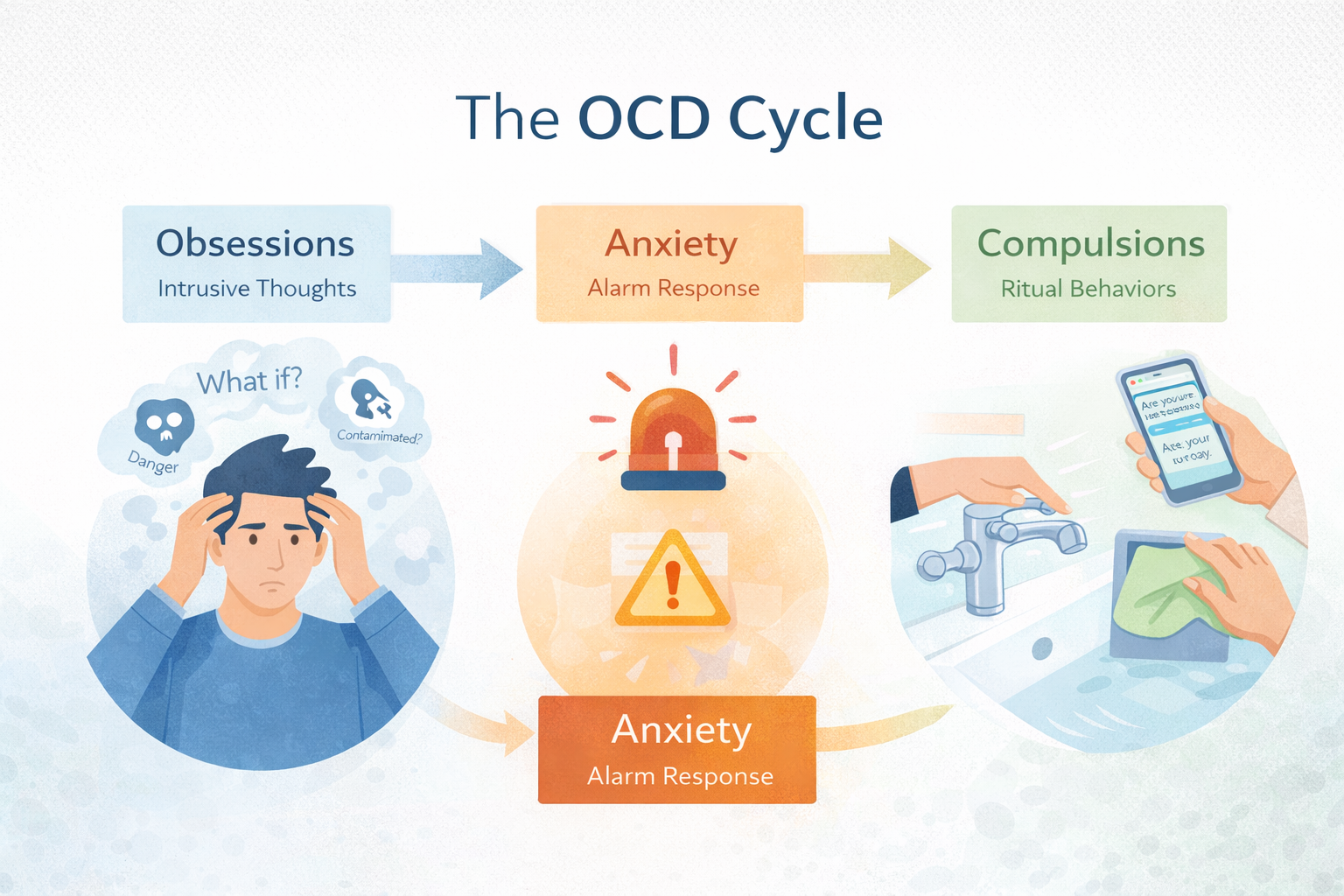
Obsessive-Compulsive Disorder (OCD) is often misunderstood as “just anxiety” or “being overly worried.” In reality, OCD is driven by a very specific and powerful pattern known as the OCD cycle . Understanding how this cycle works— obsession → anxiety → compulsion → temporary relief —is one of the most important steps toward recovery. In this post, we break down each part of the OCD cycle and explain how evidence-based treatment can help stop it. 🎥 Watch the full video explanation here:
By April Vass January 26, 2026
If you live with Obsessive-Compulsive Disorder (OCD), you’ve probably asked yourself this question more times than you can count: “I know my compulsions don’t make sense—so why can’t I just stop?” This question doesn’t mean you’re weak, unmotivated, or not trying hard enough. It means OCD is doing exactly what it does best: hijacking your brain’s fear system. In this post, we’ll explain why compulsions feel impossible to resist and how Exposure and Response Prevention (ERP) helps retrain the brain—without forcing or overwhelming you. 🎥 Watch the short video explanation here:
Chalkboard with arrows labeled
By April Vass May 20, 2025
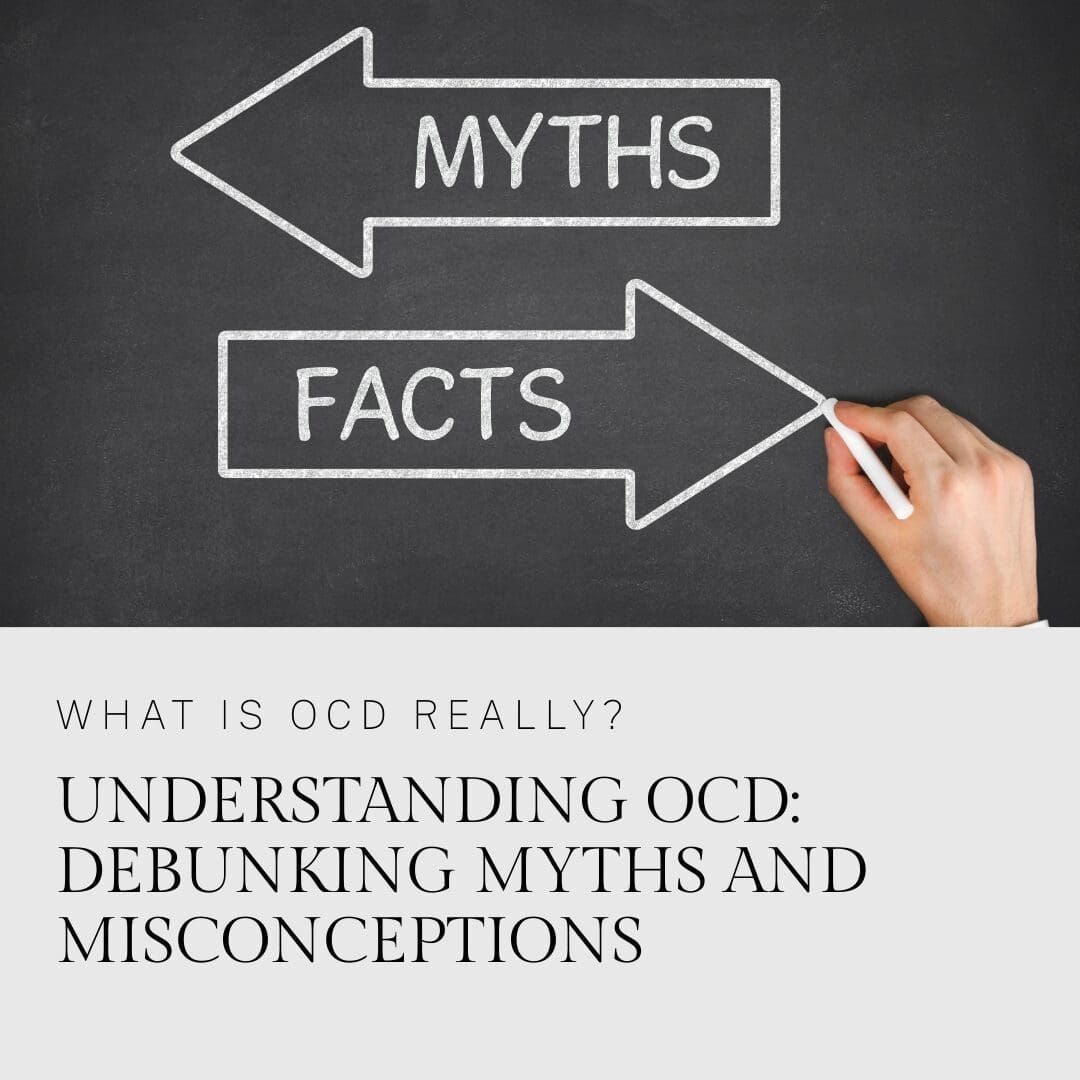
Discover the Truth About Obsessive-Compulsive Disorder “I’m so OCD about my desk being clean!” If you’ve heard this before—or maybe even said it yourself—you’re not alone. Obsessive-Compulsive Disorder (OCD) is often misunderstood. Many think it’s about cleanliness or perfectionism, but in reality, it’s a serious mental health condition that affects how people think, not just […] The post Understanding OCD: Debunking Myths and Misconceptions appeared first on ocd-wellness.com.
Laptop screen shows a blog, with title
By April Vass March 8, 2025
At OCD Wellness, we believe that knowledge is power, and our mission goes beyond providing therapy—we’re here to create a supportive space where individuals and families can access reliable, evidence-based information about OCD, tics, BFRBs, anxiety, depression, and more. With the launch of our newly updated website and blog, we’re excited to offer even more […] The post Welcome to the OCD Wellness Blog: Your Trusted Resource for OCD and Related Disorders appeared first on ocd-wellness.com.
Pink tulips in a clear glass pitcher on a wooden table, with light blue chairs in the background.
By April Vass February 28, 2025
Love should feel joyful, but if your mind is caught in a loop of “What if?”—constantly doubting your feelings or your partner—you might be experiencing Relationship OCD (ROCD). ROCD can make even the happiest relationships feel uncertain. However, the good news is that Relationship OCD is treatable, and with the right support, you can break […] The post Relationship OCD: Understanding & Overcoming Doubt in Love  appeared first on ocd-wellness.com.
A snow-covered log with
By April Vass January 7, 2025
As the calendar turns to a new year, many of us reflect on our goals and aspirations. For those living with Obsessive-Compulsive Disorder (OCD), the focus often remains consistent: regaining control and living well despite the challenges of OCD. At OCD Wellness, we believe that every year is an opportunity to deepen your recovery journey. […] The post Mastering OCD Recovery in 2025 appeared first on ocd-wellness.com.
Show More