
Understanding OCD: It’s More Than Just Cleanliness or Perfectionism

When people hear the term Obsessive-Compulsive Disorder (OCD), they often think of someone who washes their hands excessively, keeps their home immaculately organized, or is “just a little Type A.” These stereotypes are not only inaccurate—they’re harmful. They diminish the real, often debilitating experiences of those living with OCD and can prevent people from seeking the help they truly need.
At OCD Wellness, we want to set the record straight. OCD is not a quirk or personality trait—it’s a serious mental health disorder rooted in fear, doubt, and the need for certainty. And the good news? It’s highly treatable with the right support.
Debunking the Myths: OCD Isn’t What You Think
Let’s start with the biggest myth:
Myth: OCD is just about handwashing, cleaning, or being a perfectionist.
Truth: While these behaviors can be part of someone’s OCD, they’re just one small part of a much larger picture.
OCD can manifest in a wide variety of ways—many of which are invisible to others. It’s not about preferences or neatness. It’s about intrusive thoughts, compulsions, and the emotional distress that comes from trying to gain control over an uncertain world.
You might hear people say, “I’m so OCD about my closet,” but the reality is that OCD is not a descriptor for tidiness. It’s a disorder that can impact every area of life—work, relationships, parenting, daily routines, and one’s own sense of safety and identity.
What OCD Really Looks Like
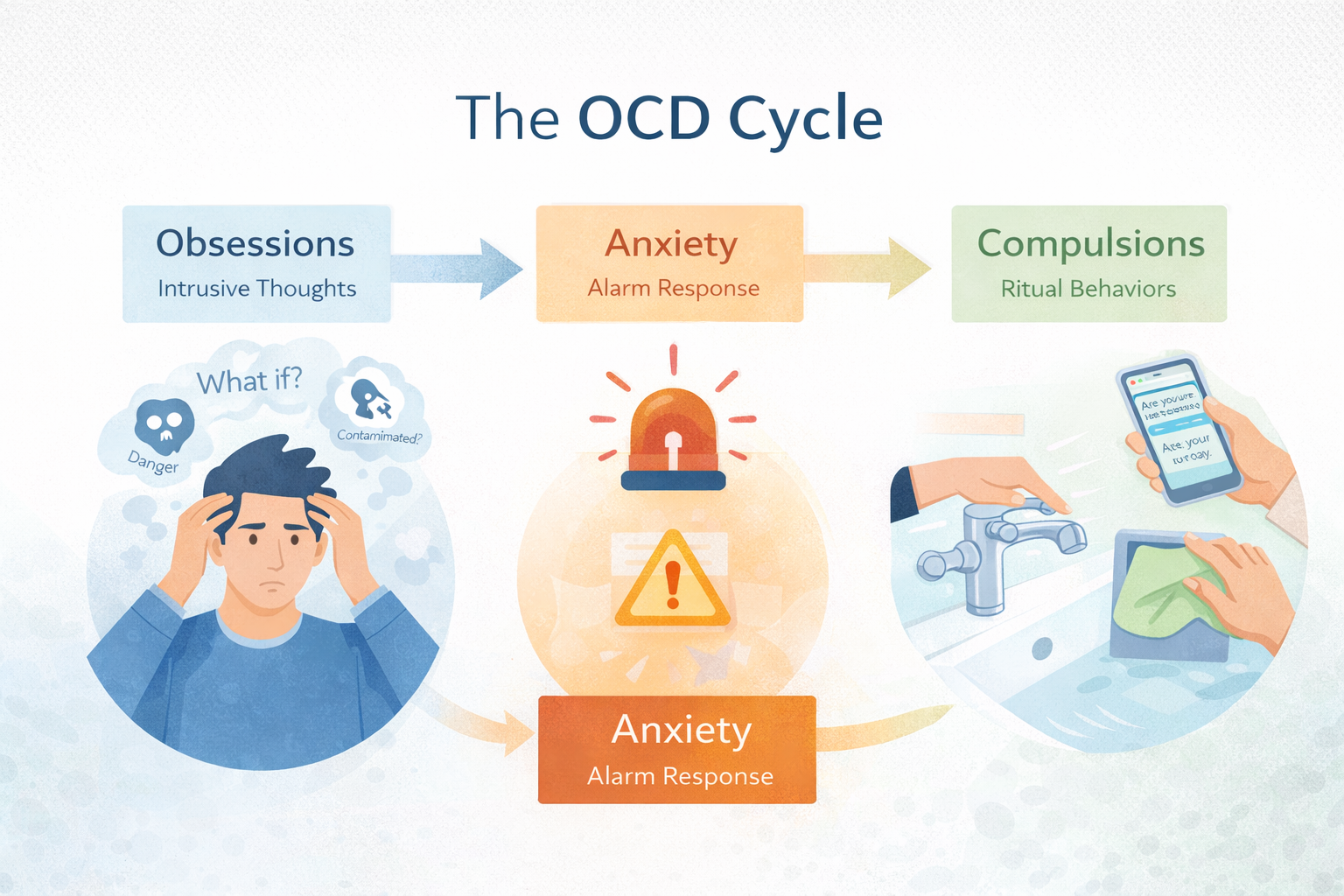
OCD is made up of two main parts:
- Obsessions – These are intrusive, unwanted thoughts, images, or urges that cause anxiety, fear, or doubt.
- Compulsions – These are the behaviors or mental acts a person feels driven to perform to reduce that distress or prevent something “bad” from happening.
Common OCD themes include:
- Contamination OCD – Fear of germs, illness, or environmental toxins.
- Harm OCD – Intrusive thoughts about accidentally or intentionally harming yourself or others.
- Moral or Religious OCD (Scrupulosity) – Fear of being immoral, sinful, or offending religious beliefs.
- “Just Right” OCD – The need for things to feel or be “just right” to relieve anxiety.
- Relationship OCD (ROCD) – Doubts and fears about one's relationship or partner.
- Sexual or Taboo OCD – Intrusive thoughts about taboo or unwanted sexual themes, including fears of being sexually attracted to children, harming someone sexually, or doubting one’s sexual orientation.
These thoughts can feel deeply distressing and shameful, especially when they clash with a person’s values or identity. Many individuals feel isolated, believing that they are the only ones experiencing such thoughts. But the truth is, you are not alone—and you are not broken.
Intrusive Thoughts Are Normal—OCD Gives Them Too Much Meaning
Everyone has intrusive thoughts. It’s part of being human. A thought like, “What if I dropped this baby?” or “Did I just offend that person?” may pop into anyone’s mind. Most people shrug them off.
For someone with OCD, though, these thoughts stick. They trigger intense anxiety and a need to find certainty, analyze, or neutralize the thought. The mind begins to make meaning out of normal sensations or thoughts, turning them into something threatening. This leads to a spiral of doubt and fear.
For example:
- “What if I’m attracted to children?” leads to avoiding children and constant self-monitoring.
- “What if I hurt someone in the past and didn’t realize it?” leads to mentally reviewing memories or seeking reassurance.
This process of meaning-making becomes a trap. Our brains crave certainty, but life is full of unknowns. OCD tries to fill in the blanks—always with the worst-case scenario—leading to endless rumination, avoidance, and distress.
Are You Stuck in the Past or Future or Searching for a Feeling?
Many people with OCD find themselves stuck in the past or future, replaying social interactions and fearing they said or did something wrong. The inner critic might say, “I should have done this,” or “What did it mean when they looked at me like that?” Or they are stuck worrying about future outcomes, often trying to predict the future with OCD quick to give an answer. Worries people may be stuck trying to answer, “What if I realize I don’t love my partner,” or “What if I lose my mind one day and cause harm?”
Others are caught seeking a specific feeling—that sense of “rightness” or certainty. If that feeling doesn’t come, they delay decisions, avoid actions, or engage in rituals to try and “get it right.” This can lead to procrastination, relationship struggles, and missing out on life.
You Are Not Alone—and There Is Help
If any of this resonates with you, know this: OCD is not your fault, and you are not alone in what you’re experiencing. The thoughts you have, no matter how distressing, do not define you. You are not a bad person, and you are not broken.
At OCD Wellness, we specialize in helping individuals like you understand their OCD, break free from its grip, and reclaim their lives. With evidence-based treatments like Exposure and Response Prevention (ERP) and Inference-Based CBT (I-CBT), you can learn to face uncertainty, let go of compulsions, and live with more peace and freedom.
Ready to Take the Next Step?
We’re here to walk alongside you—without judgment, with compassion, and with the expertise that comes from truly understanding OCD. If you’re ready to explore treatment or just want to learn more, reach out to us at OCD Wellness. Help is available—and healing is possible.