
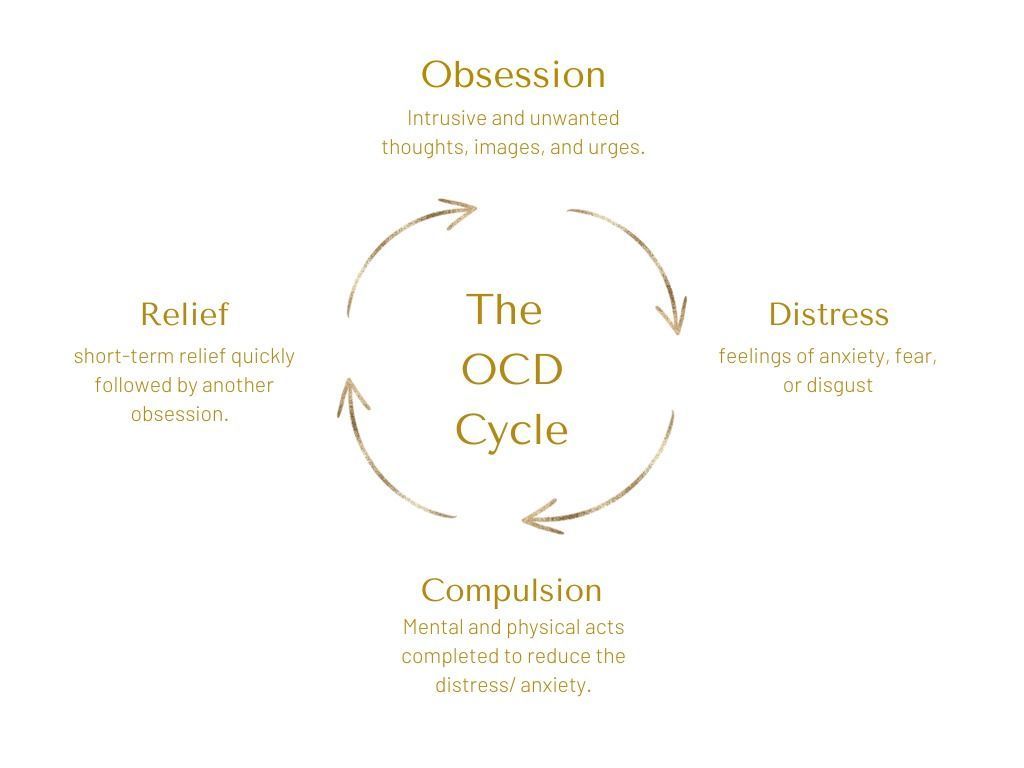
The OCD Cycle
The OCD Cycle displays how the experience of OCD develops and continues. It begins with an obsession (recurring and unwanted thoughts, feelings, urges, or sensations), creating high levels of distress. As a natural response, the individual will seek to rid the distress through a mental or physical act, known as a compulsion. Compulsions often feel helpful in the moment; however, the relief is only temporary. The cycle continues, feeling like an endless rollercoaster.
Exposure and Response Prevention is utilized to discontinue the OCD Cycle.
Obessions
Intrusive, unwanted thoughts, images, urges, or sensations that can cause significant anxiety, doubt, guilt, or discomfort. These thoughts may feel difficult to control and can center on themes such as contamination, harm, relationships, identity, or religious beliefs.
Compulsions
The repetitive behaviors or mental acts can take up significant time and may provide temporary relief from anxiety or discomfort. These compulsions can include washing, checking, counting, repeating, organizing, or mentally reviewing thoughts and actions.
Impact
Its effects can extend into many areas of life, including daily routines, relationships, work or school, self-esteem, and overall well-being. The distress and time associated with obsessions and compulsions can make everyday activities feel overwhelming or difficult.
There is HOPE
With appropriate treatment, support, and understanding, individuals can learn to manage their symptoms and reduce the impact of OCD. Recovery is possible, and people can move toward a more fulfilling and meaningful life.
Obsessions
Recurring thoughts, images, urges, or sensations, that are intrusive, unwanted, and often create uncomfortable feelings such as disgust, guilt, anxiety, or doubt. Please note, not all obsessions fall into a category and not all categories are listed.
- Sexual
- Contamination
- Violent/harm
- Religion (scrupulosity)
- Identity
- Relationship
- Real event, etc.
Compulsions
Mental and physical acts which an individual feels driven to perform as a means of reducing the uncomfortable feelings created by the obsessions. Compulsions feel necessary in the moment, and the individual often expresses a desire to not complete them. Please note, not all obsessions fall into a category and not all categories are listed.
- Washing/Cleaning
- Counting
- Repeating
- Organizing/ aligning
- Mental Compulsions – reviewing, cancelling, self-reassurance.
OCD treatment focuses on helping clients respond differently to intrusive thoughts while reducing compulsive or reassurance-seeking behaviors. Sessions are structured, goal-oriented, and guided by approaches that prioritize consistency and progress.
Clients are introduced to strategies that gradually build tolerance of uncertainty and reduce rituals or avoidance. These approaches are adapted based on individual needs and comfort level.
Over time, this structured work helps clients notice changes that extend beyond the therapy setting. The process supports both immediate symptom management and long-term resilience.
BUILDING TOLERANCE & TRUST
EXPOSURE & RESPONSE PREVENTION
TWO EVIDENCE-BASED APPROACHES
Different Approaches. One Goal: Breaking the OCD Cycle.
OCD can become a repeating cycle of intrusive thoughts, uncertainty, compulsions, and temporary relief. ERP and Inference-Based CBT (I-CBT) approach this cycle in different ways, helping clients develop the skills to respond differently to OCD and reduce the patterns that keep the cycle going.
exposure and response prevention (erp)
ERP helps individuals change how they respond to intrusive thoughts while reducing compulsions, reassurance-seeking, and avoidance. Through gradual practice, clients build greater tolerance for uncertainty and develop healthier responses to anxiety, supporting lasting symptom management and greater confidence.
inderence-based cognitive behavioral therapy (i-cbt)
I-CBT helps clients understand how obsessive doubt and patterns of reasoning contribute to OCD symptoms. By recognizing these patterns, clients can respond with greater confidence in present, reality-based information rather than imagined possibilities, supporting lasting progress in daily life.
Take the next step toward greater confidence, freedom, and control. With specialized OCD care and the right support, you can learn to manage intrusive thoughts, break free from compulsive patterns, and build a life that feels more manageable and fulfilling.
OCD treatment is for people experiencing obsessions or compulsions that are interfering with daily life, relationships, school, work, or their sense of well being.
At OCD Wellness, we support children, teens, and adults experiencing OCD and related concerns. You do not need a formal diagnosis or referral to get started. We can help determine whether OCD focused treatment is the right fit for you.
ERP — Exposure and Response Prevention
ERP focuses on helping clients change how they respond to intrusive thoughts while reducing compulsive, reassurance-seeking, and avoidance behaviors. Sessions are structured and goal-oriented, with strategies adapted to each person's individual needs and comfort level.
Through gradual practice, clients work on building greater tolerance for uncertainty while reducing the rituals and responses that reinforce the OCD cycle. Over time, these skills can extend beyond the therapy setting, supporting improved symptom management and long-term resilience.
- Focus: Building tolerance for uncertainty while reducing compulsions, reassurance-seeking, rituals, and avoidance.
I-CBT — Inference-Based Cognitive Behavioral Therapy
I-CBT focuses on helping clients understand how obsessive doubt develops and how patterns of reasoning can contribute to OCD symptoms. Treatment helps clients recognize these patterns earlier and develop strategies for responding more effectively in everyday situations.
As these skills develop, the focus shifts from automatically reacting to intrusive thoughts and imagined possibilities toward responding with greater confidence in present, reality-based information. Ongoing therapy reinforces these skills and helps clients maintain progress in their daily lives.
- Focus: Recognizing obsessional reasoning, addressing obsessive doubt, and building greater confidence in reality-based information.
Benefits of Specialized OCD Care
- Reduce intrusive thoughts and rituals
- Regain control over your time and energy
- Improve confidence in handling triggers and tolerating uncertainty
- Strengthen resilience for long-term recovery
OUR EVIDENCE-BASED TREATMENTS
- ERP (Exposure and Response Prevention): Gradually face fears in a controlled, supportive environment while resisting compulsions.
- Inference-Based CBT (I-CBT): Targets obsessional doubt at its root, helping you trust your senses and reduce reliance on imagined fears.
- SPACE for Parents: Helps caregivers support children in overcoming OCD without daily battles.
Benefits of Specialized OCD Care
- Reduce intrusive thoughts and rituals
- Regain control over your time and energy
- Improve confidence in handling triggers and tolerating uncertainty
- Strengthen resilience for long-term recovery

Who It’s For
Individuals living with OCD symptoms and Loved ones living with someone experience OCD symptoms.
Individuals do not require a diagnosis to access service
Service Questions
OCD Specialist FAQs
Why is specialized OCD therapy important for treatment?
OCD is unique and requires specialized care. Some forms of therapy may unintentionally become part of the OCD cycle by providing reassurance or encouraging ongoing analysis. ERP is designed specifically to help individuals break free from compulsions and regain control.
What types of OCD symptoms can be treated?
Treatment can address a wide range of OCD symptoms, including mental and physical compulsions, intrusive thoughts, compulsive behaviors, avoidance patterns, and anxiety related to uncertainty or control.
How are treatment plans developed for each client
Treatment plans are built based on each client’s experiences, challenges, and goals. Clinicians work collaboratively to ensure therapy remains relevant and effective throughout the process.
How long does it take to see progress in OCD therapy?
Progress varies depending on individual factors, but many clients begin to notice changes as they consistently apply strategies learned in therapy sessions over time.